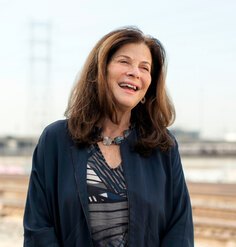
LAF Fellow Anya Domlesky is Positioning Infrastructure Adaptation as Climate Action

In densely populated U.S. cities, expanding green space or implementing climate solutions can feel daunting, particularly where undeveloped land is scarce and much of the public realm is dominated by aging or decommissioned transportation infrastructure. At the same time, the carbon costs of new materials and construction raise difficult questions, as some climate-oriented projects may take decades or even centuries to offset the emissions generated by their own creation. How can cities pursue truly sustainable solutions while convincing policymakers and residents that these investments will also improve daily life and strengthen local economies?
These issues can be complex and, at times, may seem to conflict with each other, yet 2024-25 LAF Fellow Anya Domlesky chose to tackle them in her fellowship project, Infrastructure, Rescripted: The Public Realm on a Mass Scale. The project proposes a systems-based approach to urban infrastructure that prioritizes the reuse, reallocation, and co-use of transportation infrastructure over new construction as a path toward deep decarbonization.
“Past LAF Fellows have been instrumental in thinking about how to calculate and what to calculate in embodied carbon, and [we, as a profession] began to realize that landscape architecture may actually have negative impacts. We have a carbon footprint,” Anya explained during her presentation at the 2025 LAF Innovation + Leadership Symposium. “I saw this in my own work when my lab would run performance analyses. Some fantastic projects were 200 years until carbon neutral. These were derailed by EPS foam, concrete, and steel.”
Over the last five years, landscape architecture has increasingly focused on embodied and operational carbon, addressing emissions associated with material extraction, transportation, and energy use in operations and maintenance. While these efforts have advanced sustainability and low-carbon design, Anya asserts that the field must now shift toward thinking about deep decarbonization, examining the very essence of urban building and lifestyle.
Achieving deep decarbonization in urban spaces would mean reducing new infrastructure construction, curbing outward sprawl, and prioritizing the reuse or co-use of existing materials and systems. These changes would also require a rewiring of social expectations around development and corresponding economic adjustments. Anya believes landscape architecture can drive this shift. “As a systems-based discipline, I think we have a lot more agency and influence over what happens.”
Her interest in sustainable design began early. Anya grew up in an energy-independent house designed and built by her parents through their study of sustainable building practices. After majoring in architecture, with a minor in landscape studies, at Smith College, she earned a Master of Architectural History and Theory from McGill University before deciding to pursue a more hands-on approach through a Master of Landscape Architecture at Harvard University’s Graduate School of Design.
Anya went on to join SWA Group, where she was a designer, then Director of Research, running the research and innovation lab she founded, XL Lab. To expand previous work on infrastructure adaptation, she applied for the LAF Fellowship for Innovation and Leadership. “There had been research within the firm and the lab, and it was time to start involving other practitioners and folks to start thinking about it as a more disciplinary question for the field,” she reflected.

After commencing work with her fellowship cohort of six, Anya felt her project taking shape. "Through the LAF Fellowship it went from a project that was built on a lot of data and a lot of case studies to one that was really synthesizing what that meant and what infrastructure adaptation could do.” In practice, this meant reframing underused and existing infrastructure as a climate asset by demonstrating how reuse and redesign could reduce embodied carbon, support low-carbon mobility, and expand the public realm without relying on new construction.
Research synthesis projects like this enable practitioners to translate findings into evidence-based insights for lawmakers, philanthropic partners, and community stakeholders who play a major role in supporting landscape architecture work. One infrastructure adaptation pathway highlighted by Anya’s research is roadway reuse. Converting car-oriented roadways into bike or pedestrian corridors, often paired with new or expanded greenspace, can significantly reduce embodied carbon by avoiding demolition and new construction while also encouraging low-carbon transportation. These interventions help catalyze the broader social and behavioral shifts required to achieve deep decarbonization.
Sharing this research with the broader landscape architecture community is central to the LAF Fellowship. “One of the most valuable things about the fellowship was making those ideas public and circulating them from the platform of LAF, which has so many folks involved in practice — folks that are interested in performance and what landscape can achieve,” she said.
As a recognized leader in practice-based research, Anya is frequently approached by rising designers eager to dedicate more of their time to inquiry. “For those looking to get involved in research, I always say the field will probably look very different when you are my age, but what you can prepare yourself for is to be not only flexible, but opportunistic. Keep your eyes open, look at what people are doing,” Anya advised. “Firms that are more adventurous are thinking about the value proposition of design and how to operate in a competitive field and may be more interested in practice-based research and other forms of innovation.”
You can watch Anya's presentation from the 2025 LAF Innovation + Leadership Symposium here.