Research Update: Management of Biodiverse Landscapes
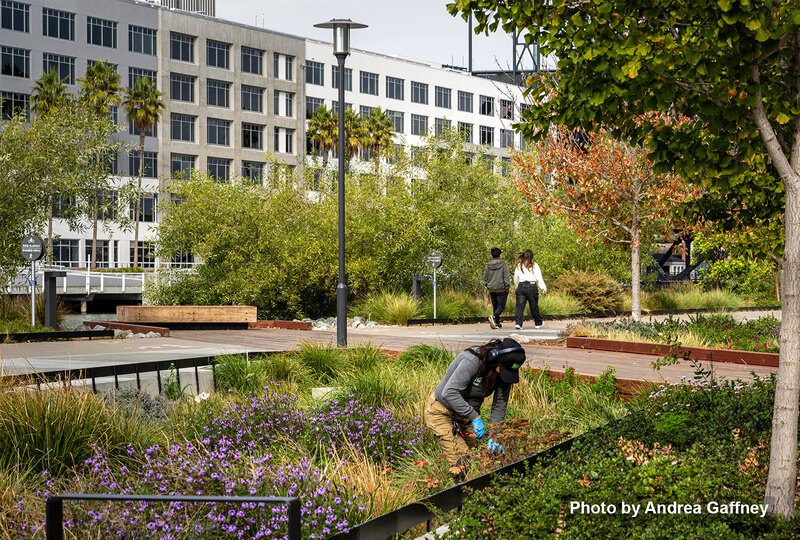
The LAF Research Grant in Honor of Deb Mitchell supports research relevant to design practice. The 2025 grant was awarded to “Keeping Up: Maintenance and Management of Ecologically Vibrant Landscapes.” The 12-month research project is being conducted by Brenna Castro of Atlas Lab and research partner Haven Kiers of the University of California, Davis. Six months into the project, they provided an update on their progress.
The research focuses on maintenance-related challenges to creating habitat and increasing biodiversity in large-scale public and institutional landscapes, which typically face limited maintenance budgets yet serve diverse and often disadvantaged communities. The research team is working to catalog current management approaches, identify systemic obstacles, and explore successful strategies that support biodiversity, including alternative funding models, staff training programs, community stewardship programs, and innovative maintenance practices.
Their first phase of work consisted of two coordinated national surveys: one for designers and one for maintenance professionals. The goal was to develop a comprehensive understanding of the systemic obstacles preventing the widespread adoption of high-biodiversity landscapes in large-scape public and institutional settings.
The surveys were distributed through partner capacity organizations (including LAF) to reach professionals across a wide range of regions and organizational contexts. The survey received strong national participation, with responses from 158 designers (primarily landscape architects) and 109 maintenance professionals (including gardeners, horticulturalists, and landscape managers.) The team also conducted more than 20 in-depth interviews with a smaller group of landscape architects to gain nuanced insights on challenges and opportunities.
Preliminary findings from Phase 1 reveal a high level of agreement between designers and maintenance professionals on the importance of biodiversity and the challenges of achieving it at scale. Both groups reported widespread use of basic practices such as planting regionally native species, removing invasive species, and protecting or restoring habitat and soils. However, there were significant gaps in goal setting, monitoring, and long-term management of biodiverse landscapes.
The primary systemic barriers identified through surveys and interviews include:
Know-How: There is significant lack of training and technical expertise among maintenance personnel tasked with managing complex, ecologically rich landscapes.
Funding: Limited funding and resources prevent organizations from dedicating the time and labor needed to support biodiversity over the long term.
Collaboration: Weak communication and coordination between designers, owners, and maintenance staff lead to mismatched expectations and inconsistent management practices.
One-Size-Fits-All: Traditional landscape maintenance firms often lack the capacity, equipment, and experience required to successfully care for biodiverse landscapes.
Aesthetic Norms: Conventional norms and expectations for manicured, uniform aesthetics create resistance to naturalistic planting approaches.
By bringing these barriers into focus, this research lays the groundwork to support sustainable management and help biodiversity thrive in public and institutional landscapes.
The next phases of the research include documentation of case studies of existing projects, creation of an advocacy fact sheet, and production of a handbook-style “UpKeep Catalog” with references and resources. These products aim to empower landscape architects and land managers to catalyze fundamental shifts in how landscape maintenance is conceptualized, practiced, and evaluated to support high-biodiversity landscapes over the long-term.
The project concludes in summer 2026. In addition to the release of the full set of products, look for an LAF webinar showcasing the research process and findings.