Research Exchange Gathering a Success
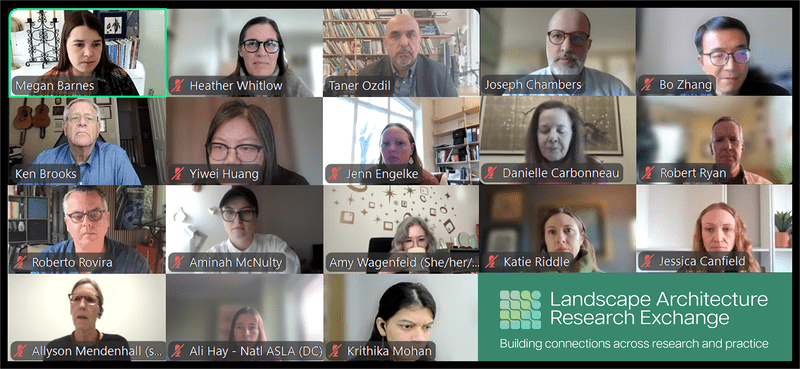
On January 22, 2026, the Landscape Architecture Foundation (LAF) and the Council of Educators in Landscape Architecture (CELA) hosted the Landscape Architecture Research Exchange, a first-of-its-kind virtual gathering for academic and professional practitioners to identify shared research interests, explore opportunities for collaboration, and begin to shape a responsive research agenda for landscape architecture.
After introductory remarks from the organizers, 105 participants joined 17 volunteer facilitators to discuss their research interests and needs during two small-group speed networking sessions. Each group was assembled using information attendees provided during registration, with each group having a mix of academic and professional practitioners. Participants hailed from not only across the United States and Canada but also from nine additional countries. They crossed all professional levels from early-career to mid-career, combining long-term perspectives with emerging research ideas and new energy.
Many participants reported successfully making new connections and exchanging contact information with others, achieving a key goal of this event to “matchmake” for potential future research collaborations.
Round 1 Conversations: Research Topics
The participants’ research interests showed strong alignment around a set of shared priorities, which provides a snapshot of the current most pressing topics for practitioners in landscape architecture.
Climate resilience and adaptation were a dominant theme, with participants expressing the desire to explore how landscapes can respond to increasing uncertainty, from extreme weather and sea level rise to drought and wildfire. Closely related interests included carbon, energy, and other mitigation strategies, reflecting a desire to better understand the role of landscapes in addressing climate change. Water systems and management were also prominent, including stormwater, flooding, and riverine and coastal processes, alongside interest in the long-term performance of blue-green infrastructure.
Many participants expressed growing interest in technology, data, and emerging tools, including digital modeling and artificial intelligence (AI), and how these tools can support better design and decision-making. Many participants are exploring how new tools can enhance insight while raising important questions about ethics, access, and applicability in practice.
Health, wellbeing, and social outcomes were also widely represented. Participants described interests in mental health, therapeutic landscapes, public space, and the role of design in supporting physical and social wellbeing — often alongside questions about how to measure and communicate these benefits effectively.
A significant number of registrants highlighted equity, justice, and community-centered research, emphasizing belonging, inclusive engagement, and the need to better integrate lived experience and social context into landscape research and practice.
Finally, many participants identified interests in ecology, restoration, materials, soils, and planting systems, including native plants, horticulture, habitat restoration, and regenerative approaches. These interests often navigated the gap between ecological science and implementation realities, reflecting a shared desired for more applied, practice-relevant research.
Round 2 Conversations: Opportunities and Constraints of Collaborative Research
While the first round of breakout groups was topic-based, the second round was centered around how collaboration between academic and professional practitioners actually happens and how it could be better supported.
Across the 17 breakout groups, participants consistently emphasized that a lack of interest in pursuing research is not what limits collaboration. Instead, conversations continually returned to structural barriers: lack of time, limited funding, misaligned incentives, and the absence of clear pathways for collaboration. Practitioners described wanting to engage more deeply with research but that they face tight fees, risk-averse clients, and contracts that do not reward post-occupancy evaluation or long-term monitoring. Academics, meanwhile, noted the tension between research rigor, publication timelines, and the realities of fast-moving projects and political change.
Several groups highlighted challenges related to access and limited feedback loops. Research findings are often inaccessible or inconveniently shared in journals, reports, or individual projects, with few mechanisms for sharing results broadly or learning from outcomes, especially when findings are uncertain or incomplete. Participants expressed frustration that valuable project-based research frequently “dies with the project,” rather than contributing to a shared body of knowledge the profession can build on.
Discussions around data, technology, and emerging tools reinforced this point. While participants saw major potential in AI, modeling, sensing, and visualization, they stressed that these tools are often used without sufficient validation or post-occupancy feedback. Without routine performance monitoring, confidence in simulations and projections remains limited. Many participants called for research that embeds evaluation into practice as a standard expectation supported by policy, permitting, and/or funding structures.
Another recurring theme was scale. Pilot projects and small research efforts were widely viewed as essential for experimentation and learning, but participants noted how difficult it is to scale promising ideas into broader practice or policy change. Smaller, more accessible research efforts were seen as more feasible than large, comprehensive studies, particularly for small firms or solo practitioners, but only if there are clear pathways for aggregation, dissemination, and long-term stewardship of results.
Across multiple groups, participants pointed to the need for stronger connective infrastructure: clearer guidance on how to initiate collaborations, access to funding and mentorship, shared repositories of case studies like LAF's Landscape Performance Series, and platforms for early feedback before research is finalized or published. Organizations like LAF and CELA were frequently cited as conveners, translators, and champions able to lower barriers, surface shared questions, and align research agendas with real-world needs.
Participants expressed strong interest in continued connection through future exchanges, resource libraries, matchmaking opportunities, and integration with existing professional gatherings. Many emphasized the value of developing a shared research roadmap, advocating for policies that require or incentivize post-occupancy evaluation, and learning from other disciplines, such as public health and medicine, that have more established research-practice pipelines.
Taken together, the second round of discussions indicates that the profession is ready to move beyond isolated efforts toward more coordinated, transparent, and actionable research collaborations. What’s needed now is not just enthusiasm, but the structures, incentives, and support systems to turn shared curiosity into sustained impact for the discipline.
LAF and CELA will be gathering feedback from the event and using the expressed research needs and interests to inform next steps, including a discussion at the 2026 CELA conference Catalyzing Connections in Cincinnati, Ohio in March.
A heartfelt thank-you to all facilitators and participants in this pilot event!
Partners and Sponsors
-
Partner
-

Partner
-

Sponsor